Tuesday, 7 February 2012

Research

Research - How Game Designers Use Story to Improve Gameplay Experience


A lot of the time, games designers use narration as a form of storytelling. They will start the game with a cutscene that is interesting to watch, which will have a narrator or the main character's voice speaking to explain current situations in-game, or the back story of the game's history. Sometimes, the story can be told by items picked up in game, such as in Resident Evil you can find journals which have nuggets of information in them. The way that the story is played can improve gameplay by telling you exactly what is going on and placing you squarely into the game.
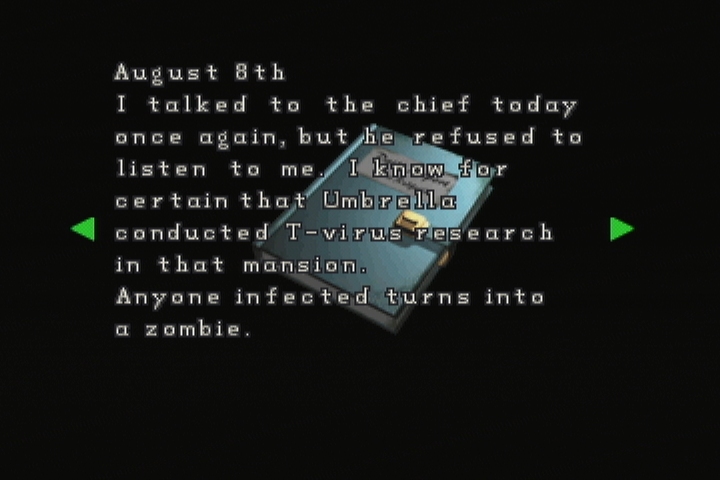

The journals in Resident Evil. A screen comes up when you want to read them. In other games, the story is spoken whilst you are playing so it is possible to miss things. There are even still more ways, there could be sections in the menu specifically for learning the story, such as a 'library' to look through at various pieces of information.


Depending on the style of the game and the player's preferences, certain games and types of games may appeal more. To a first-person shooter fan, a game like Call of Duty (which is a first-person shooter or "FPS") would be ideal and on that basis alone it would probably be enjoyable for that person, sometimes regardless of the quality. However, if a person does not have any preferences when it comes to games, then the game's style has no impact on whether the player will enjoy it. It is then up to the game itself to be a good game of its kind.
It is still true, however, that a game can be so unenjoyable that the player would rather play different games even if this unenjoyable game is their preferred type of game.

Sometimes in a game, there are many background images/scenes and objects that do not particularly influence the game directly, but do enhance the gameplay. If a game has well-drawn or painted backgrounds, the player may feel as if they are more 'into' the game than if it was sloppily drawn. Also, if a character looks better and more detailed, the player may subliminally think higher of that character (or lower, depending on if the character is good or bad). An example of good artwork in games is the Street Fighter franchise. They are known for their artistic approach to the characters and scenes. This may not seem like the main pulling power, but it is definitely one of the iconic parts of the games.


This is an example of artwork of the Street Fighter games. Very different to other fighting games.


Some games like to show emotion. In a game, it can be hard to show emotion, as to convey emotion you would need to hear a voice clearly, see a face's reactions, and see any hand gestures they may make. This can be hard or tedious to programme into a game, so it may not be worth it in some developers' eyes.

Tuesday, 17 January 2012

Writing Exercises


FIRST IMAGE

Fiery, Hot, Monotonous, Grey, Chaotic, Crazy, Pointless, Old, Abstract, Illogical, Dangerous, Powerful, Strong, Meaningful, Unnecessary?, Brave, Odd, Mad

SECOND IMAGE

Sitting calmly, Waiting patiently, Thinking crazily, Talking quietly, Speaking meaningfully, Sitting stupidly, Chilling peacefully, Chatting inappropriately, Sadly waiting, Sitting unacceptably, Relaxing oddly, Smiling happily

DREAM

I was sat fearfully in a misty opening one night. All of a sudden, a humongous avian creature charged forcefully through the thick, concealing air that surrounded me. This large purveyor of fear bared its powerful talons and managed to pick me up off the floor.

I tightly grabbed one of the massive creature’s talons and bent it sideways, with haste but lacking in logical thought. This gargantuan beast then proceeded to release its tremendous grip on me from the precarious height at which I was being held, causing me to let out an exasperated scream. As I fell, the ant-sized landscape below slowly shifted into a wasteland of vast proportions.
As I came closer and closer towards it, I realised I was dreaming, mere seconds before hitting the ground.

Then I woke up.

ADVERB: RED
ADJECTIVE: BLUE


DREAM

I was sat in a opening one night. All of a sudden, a avian creature charged through the, air that surrounded me. This purveyor of fear bared its talons and managed to pick me up off the floor.

I grabbed one of the creature’s talons and bent it sideways, with haste but lacking in logical thought. This beast then proceeded to release its grip on me from the height at which I was being held, causing me to let out an scream. As I fell, the landscape below shifted into a wasteland.
As I came closer and closer towards it, I realised I was dreaming, mere seconds before hitting the ground.

Then I woke up.


“Man sticks camera in mouth of tiger shark as he survives attack”
By Elliot Fenton, 24/1/12

An eccentric man survives a deadly attack by a tiger shark whilst taking photographs on Cat Island.

Nigel McNails, 26, from Inverness, Scotland, said this of the attack “I may be lucky to be alive, but I enjoy taking these photographs too much to stop”. While this isn’t advised, because it is very dangerous (as we’ve seen), it looks like Nigel will continue with his favourite hobby of photographing sharks.

McNails explains that sharks have a certain method of finding out what is what. He says that “sharks bite things to find out what they are” and it looks like one shark in particular took an interest in McNails. As the shark was swimming towards McNails with its mouth, he knew it wanted a piece of him.

With some quick thinking, he managed to thrust his camera forward and take a lifesaving photograph at just the right time. The shark bit the camera, giving Nigel the important few seconds to get away from the shark.


Nigel McNails claims that he goes shark photography on Cat Island at least three times a year alone. “I go whenever I can and work allows it – usually once near Christmas time and a couple of times during the summer.”
“I enjoy taking pictures of these sharks because it’s kind of like an adrenaline rush, like riding on a rollercoaster, except in this case I get to keep the photographs afterwards.”

McNails’ claims of it being an adrenaline rush likely come from the fact that it puts him in danger, which as we know increases adrenaline. The only difference between what he compared it to, a rollercoaster, is that with a rollercoaster the danger is never real danger, as it is in a controlled environment for which to keep safe.